
July Free Reads: Happy Birthday America!
By Lindsey Golden · July 7, 2026
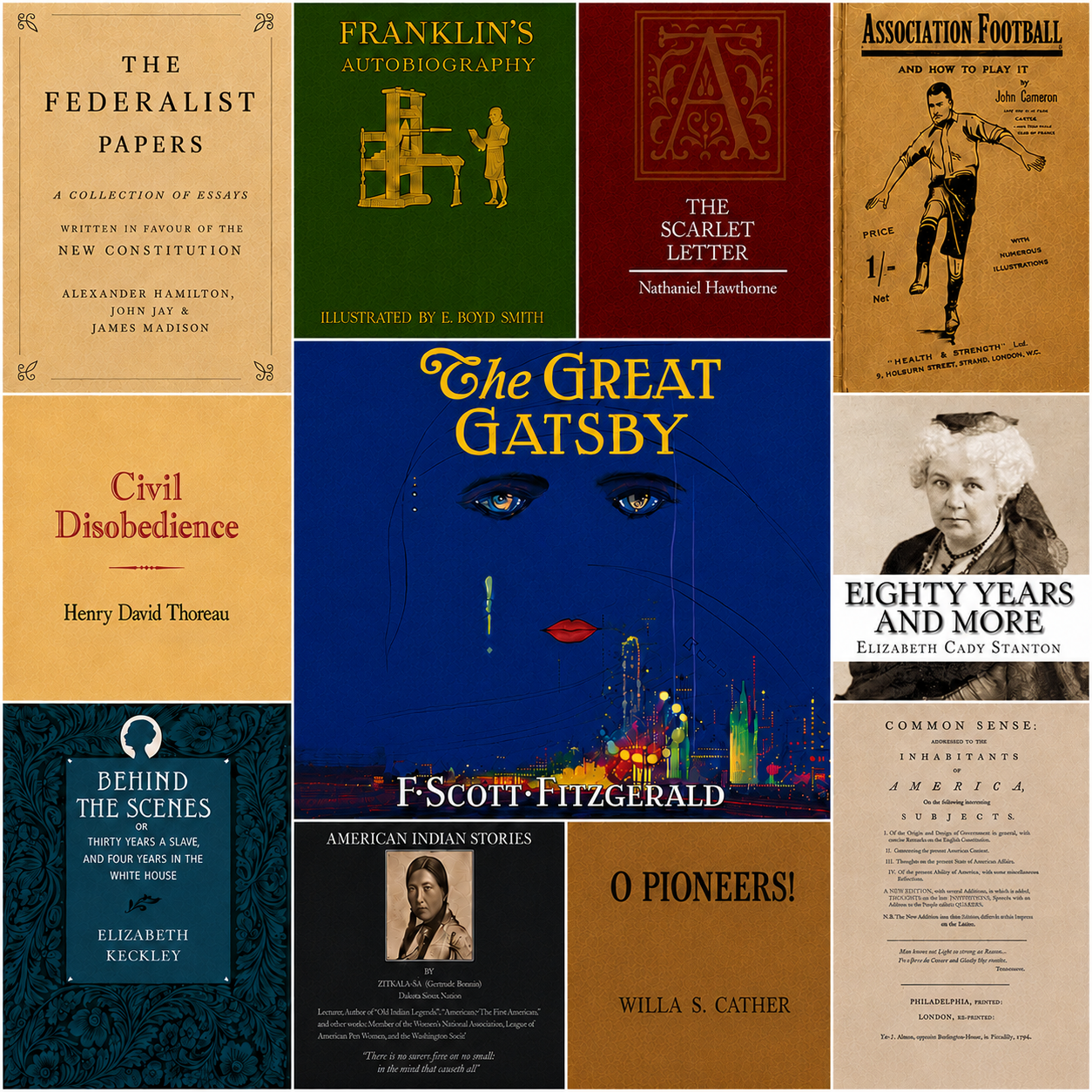
Prepared in honor of America’s 250th anniversary, our July Free Reads collection gathers public-domain classics that have shaped how Americans understand their country and themselves. It includes foundational political writing, life stories from major American figures and communities, and novels that capture different eras of U.S. history. Across the collection, you will encounter the experiences of founders of the country, immigrants and pioneers building new lives, enslaved people fighting for freedom, women demanding political equality, and Native writers preserving culture under pressure from forced assimilation. Together, these works show America’s history of wrestling with what freedom, equality, and belonging should mean.
We know not all of our readers are American, so we’re also including one classic in honor of the World Cup: Association Football, and How To Play It (John Cameron, 1908), an early guide to the beautiful game.
You can add these titles directly to your own library–we’ve already converted them to audio for you with Paper2Audio’s text to speech technology, so it won’t even take up any of your audio generation limit! Just click on any of the links below and then click “Save for later” at the top of the document to add it to your listening queue.
We’ve included these free audiobook classics for their literary and historical value, but we also recognize that like many materials from earlier eras, these may contain outdated language, stereotypes, or social attitudes that can be hurtful or uncomfortable for modern readers.
Political Commentary
Common Sense by Thomas Paine (1776)
A short, forceful pamphlet arguing that the American colonies should break from Britain and form an independent republic. It helped turn revolutionary sentiment into a direct case for independence and made separation from Britain feel not only possible, but practical, urgent, and morally necessary.
The Federalist Papers by Alexander Hamilton, James Madison, and John Jay (1787-1788)
A series of essays defending the proposed U.S. Constitution. They explain federalism, checks and balances, separation of powers, the presidency, the courts, and the dangers of faction, and these ideas still shape how Americans argue about democracy and institutions.
Civil Disobedience by Henry David Thoreau (1849)
A brief essay on refusing to cooperate with unjust government. Its influence reaches far beyond its moment, inspiring later movements for abolition, civil rights, antiwar protest, and nonviolent resistance.
Notable Autobiographies
The Autobiography of Benjamin Franklin (1791)
A classic account of self-education, ambition, work, invention, and civic improvement. It helped define the American ideal of the self-made person, while also showing how individual success was tied to public institutions, community, and practical knowledge.
Behind the Scenes: Or, Thirty Years a Slave, and Four Years in the White House by Elizabeth Keckley (1868)
Keckley survived slavery, bought her freedom, and reinvented herself as one of Washington’s most sought-after dressmakers. By the Civil War, she was dressing Mary Todd Lincoln and seeing the White House from a place almost no Black woman of her time could. Her skill brought her into Mary Todd Lincoln’s inner circle, giving her a rare view of the Civil War White House, Lincoln’s assassination, and the First Lady’s unraveling afterward. When the book was first published, people treated it like a scandal because it revealed private moments from the Lincoln household. Today, historians view it as valuable testimony of a woman making her own way through slavery, freedom, and power.
Eighty Years and More by Elizabeth Cady Stanton (1898)
A memoir of women’s rights organizing across the 19th century, from family life and religion to public speaking and suffrage. It captures how political change often begins in ordinary exclusions, then grows into institutions, conventions, arguments, and movements.
American Indian Stories by Zitkala-Sa (1921)
A blend of childhood memory, Dakota tribal stories, and critique of forced assimilation of Native Americans. Its enduring power comes from showing Native life not as a vanishing backdrop to U.S. expansion, but as a living culture under pressure from schools, religion, and federal policy.
Great American Novels
The Scarlet Letter by Nathaniel Hawthorne (1850)
A novel about punishment, secrecy, gender, and moral judgment in Puritan New England. Its influence comes from turning early American religious life into a lasting myth about shame, conscience, hypocrisy, and the individual against the community.
O Pioneers! by Willa Cather (1913)
A prairie novel about immigrant settlement, land, endurance, and family duty in Nebraska. It shows American expansion through work rather than conquest: the slow transformation of harsh land into home, and the costs carried by the people who make that possible.
The Great Gatsby by F. Scott Fitzgerald (1925)
A Jazz Age novel about wealth, reinvention, longing, and illusion. It became the classic portrait of the American Dream’s seduction and emptiness: the belief that a person can remake himself, and the tragedy of discovering what money cannot buy.