
Spooky Free Reads: Mysteries, Monsters and Haunted Classics
By Lindsey Golden · October 16, 2026
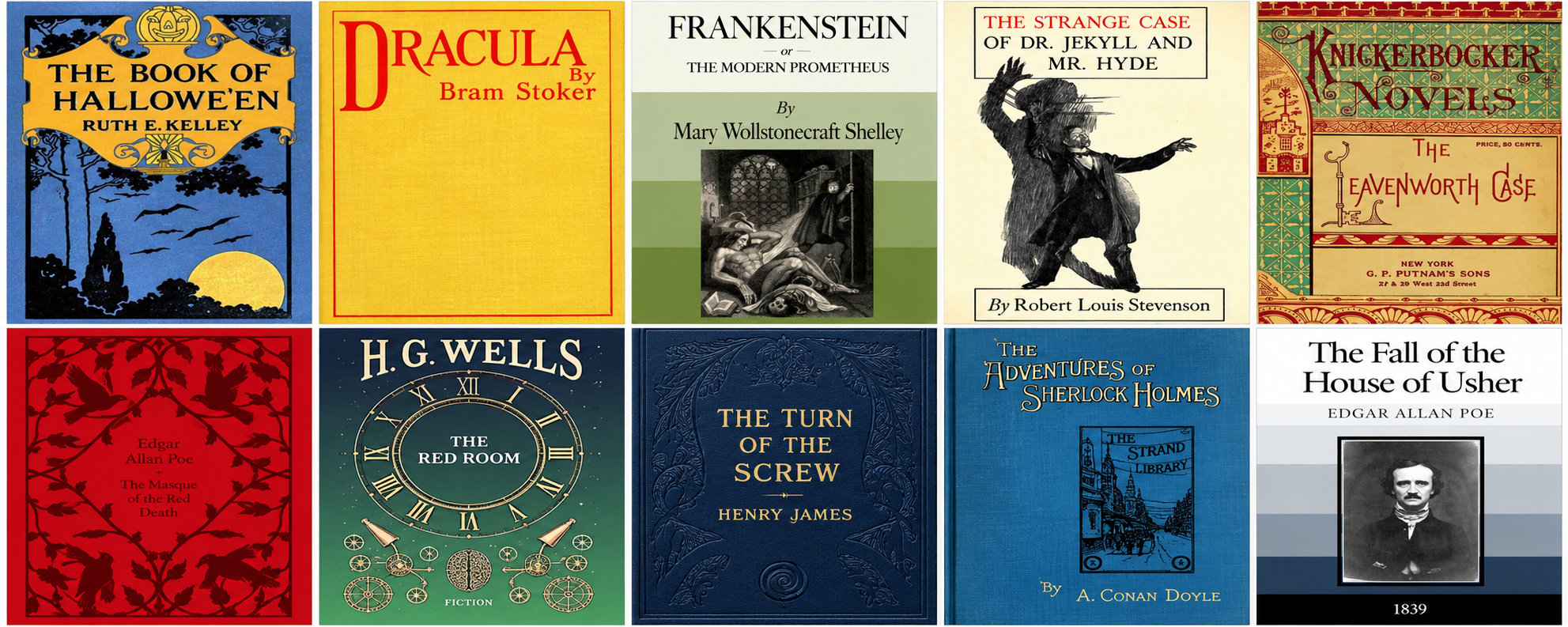
Just in time for Halloween, we’re celebrating the darker side of the classics. These books and short stories go back to the roots of mystery and horror, with ten classics that helped teach generations of writers how to make readers uneasy. The stories explore hidden crimes, dangerous experiments, haunted rooms, monsters hiding in plain sight, and characters who discover (usually too late) that the rational explanation they were hoping for may not exist.
There’s plenty here for a dark October night, from detective stories and Gothic nightmares to some of the most enduring monsters in literature. And for anyone curious about where all this seasonal fascination with ghosts, witches, omens, and the dead came from, the collection also includes an early history of Halloween and its traditions.
You can add these titles directly to your own library. We’ve already prepared them for audio with Paper2Audio, so listening to them won’t count against your weekly limit. Just click on any of the links below and then click “Save for later” at the top of the document to add it to your library. You can also save them for offline listening after adding to your library by clicking on the document menu and selecting “Offline audio.”
We’ve included these classics for their literary, historical, and entertainment value. Like many works from earlier eras, some contain violence, disturbing themes, or language and cultural attitudes that may be considered outdated or offensive today.
Monster Mash
Frankenstein by Mary Shelley (1818)
Victor Frankenstein is a young scientist consumed by the possibility that he can discover the secret of life itself. When he succeeds in bringing a being assembled from dead bodies to life, however, he recoils from what he has created. Abandoned by his creator, the intelligent and deeply lonely creature must make sense of humanity and of his own place outside it. Often remembered simply as a monster story, Frankenstein is also a novel about ambition, responsibility, prejudice, and the consequences of creating something you cannot control.
Dracula by Bram Stoker (1897)
When a young solicitor travels to a remote castle in Transylvania to assist the mysterious Count Dracula with a property purchase in England, he gradually realizes that his host is far more dangerous than he first appears. Told through journal entries, letters, telegrams, newspaper articles, and other documents, Dracula combines Gothic horror with mystery and adventure and created many of the images and conventions that continue to define vampire stories more than a century later.
Thriller (Gothic Horror)
The Fall of the House of Usher by Edgar Allan Poe (1839)
An unnamed narrator travels to the decaying country home of his childhood friend, who is suffering from a mysterious illness and an overwhelming sense of dread. As the narrator remains at the house, its oppressive atmosphere becomes increasingly difficult to separate from the troubled family itself. One of Poe’s best-known stories, it includes many of the defining elements of Gothic horror into a relatively short listen: an isolated mansion, a doomed family, psychological terror, and a growing uncertainty about what is real.
The Masque of the Red Death by Edgar Allan Poe (1842)
A devastating disease known as the Red Death is sweeping through the country, but a wealthy prince believes he and his guests can escape it by sealing themselves inside a fortified abbey. Months into their isolation, he holds an elaborate masquerade across a series of brilliantly decorated rooms, until an unexpected guest appears among the revelers. Although it is one of Poe’s shortest stories, it is among the most memorable as it uses its strange setting and relentless sense of approaching danger to explore mortality and the impossibility of insulating ourselves completely from the world outside.
Ghost Busters
The Red Room by H.G. Wells (1894)
A young governess accepts a job caring for two children at an isolated English country estate. At first the children seem almost impossibly charming, but the governess soon begins seeing mysterious figures around the grounds and becomes convinced that something dangerous is threatening them. Readers have debated for more than a century whether the governess is witnessing a genuine supernatural haunting, misunderstanding the events around her, or becoming an unreliable observer herself. That ambiguity has made the novella one of literature’s most enduring ghost stories.
The Turn of the Screw by Henry James (1898)
A young governess accepts a job caring for two children at an isolated English country estate. At first the children seem almost impossibly charming, but the governess soon begins seeing mysterious figures around the grounds and becomes convinced that something dangerous is threatening them. Readers have debated for more than a century whether the governess is witnessing a genuine supernatural haunting, misunderstanding the events around her, or becoming an unreliable observer herself. That ambiguity has made the novella one of literature’s most enduring ghost stories.
Trick or Treat (Mysteries)
The Leavenworth Case by Anna Katharine Green (1878)
One of the earliest successful American detective novels, which helped establish many features that would later become staples of the genre, like forensic clues, competing suspects, and a seemingly impossible murder. When a wealthy man is found shot to death inside his New York mansion, suspicion quickly falls on members of his own household, particularly the two nieces who stand to inherit his fortune. Investigators must sort through contradictory testimony, hidden relationships, missing evidence, and family secrets in search of the truth.
The Strange Case of Dr. Jekyll and Mr. Hyde by Robert Louis Stevenson (1886)
A London lawyer becomes increasingly concerned about the relationship between his respectable friend Dr. Henry Jekyll and a disturbing man named Edward Hyde. As Hyde’s behavior grows more violent and Jekyll becomes increasingly secretive, Utterson tries to discover the connection between them. The basic premise of Jekyll and Hyde has become so famous that it can be easy to forget the original book is structured as a mystery. The story gradually reveals what is happening through witness accounts, documents and investigation while exploring questions about identity, self-control, and the conflicting sides of human nature.
The Adventures of Sherlock Holmes by Arthur Conan Doyle (1892)
Across twelve short stories, private detective Sherlock Holmes and his friend Dr. John Watson take on cases involving mysterious disappearances, unusual crimes, secret societies, suspicious deaths, and puzzles that seem impossible until Holmes applies his powers of observation and deduction. The collection includes some of Holmes’s most famous cases, including “A Scandal in Bohemia,” “The Red-Headed League,” “The Adventure of the Speckled Band,” and “The Five Orange Pips.” These stories helped establish the model for the brilliant fictional detective and influenced generations of mystery writers who followed.
This is Halloween
The Book of Hallowe'en by Ruth Edna Kelley (1919)
Where did Halloween come from, and how did bonfires, ghosts, witches, fortune-telling, jack-o’-lanterns, and other traditions become part of the holiday? The Book of Hallowe’en, one of the earliest book-length histories of Halloween, traces the holiday through ancient seasonal festivals and centuries of folklore and customs. It explores everything from witches and omens to Halloween games, parties, and divination traditions. The narrative history also includes passages from relevant literature and poetry.
The book is also a historical artifact in its own right, as some of Kelley’s explanations reflect the folklore scholarship and assumptions of her era rather than current historical consensus. It offers a fascinating look at both Halloween traditions and how people understood their origins more than a century ago.